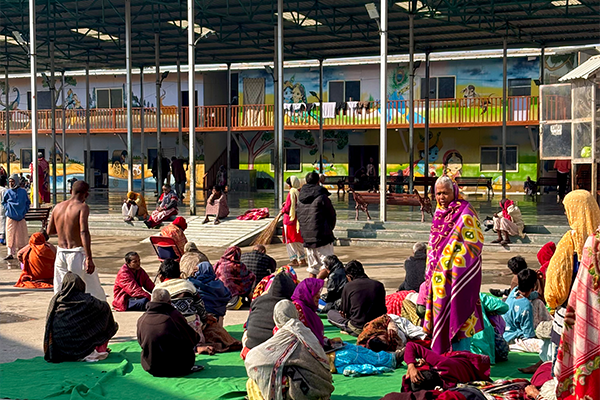
There is a version of social service that is transactional. A meal is prepared and handed over. A bed is provided. A medical need is attended to. The person receiving these things is grateful, or they are not. The person providing them feels useful, or they do not. And then tomorrow arrives and the cycle repeats.
This version is not nothing. The meal matters. The bed matters. The medicine matters. There is no dignity without survival, and survival requires exactly these things.
But survival is not dignity. And the conflation of the two – the assumption that meeting basic physical needs constitutes the full scope of what destitute people require – is one of the quiet failures at the heart of how India thinks about social welfare.
This piece is an attempt to think through what dignity actually means in the context of care for abandoned and destitute individuals – and why it matters not just morally, but practically.
What Dignity Is Not
Dignity is not a luxury. This is perhaps the most important thing to establish at the outset, because there is a persistent instinct – particularly in resource-constrained environments – to treat dignity as a finishing touch: something you add once the essentials are covered, if there is time and budget left over.
This instinct is understandable. When you are managing a shelter home with limited staff and a constant flow of people in acute need, it is easy to organise your priorities around the visible and the urgent. The person who needs a wound dressed. The person who has not eaten in three days. The person who arrived overnight and needs to be assessed.
But dignity is not what remains after those things are handled. It is woven into how those things are handled. The wound is dressed – but is it dressed with impatience, with the brisk efficiency of someone who has too many other things to do? Or is it dressed by someone who speaks to the person during the process, who explains what they are doing, who treats the person’s pain as something worth taking seriously rather than simply a medical task to be completed?
The difference is invisible in any operational report. It is entirely visible to the person receiving the care.
The Specific Wound of Abandonment
To understand why dignity is so central to the care of destitute individuals specifically, it helps to understand the particular nature of their situation.
Most destitute individuals – particularly those who have been abandoned by families – have not simply lost their material circumstances. They have lost something more fundamental: the experience of being someone who matters to another person. Of being known. Of being the kind of person whose absence would be noticed.
When a person is left on a pavement by their family, or discharged from a hospital into nothing, or found wandering a city that does not know their name – the material deprivation is the visible part of a deeper injury. The deeper injury is to their sense of personhood. The message their circumstances have sent them, repeatedly and consistently, is: you are not important enough to be kept.
Food and shelter address the material deprivation. They do not, on their own, address this deeper injury.
Dignity does. Not in a single gesture, but through the accumulation of countless small signals, delivered consistently over time, that tell a different story: you are here, we know you are here, and your presence matters.
What Dignity Looks Like in Practice
Dignity in the context of destitute care is not an abstract principle. It has a texture. It shows up in specific, observable ways – and its absence shows up just as specifically.
It is the difference between addressing someone by name and addressing them by their bed number. Between sitting down when you speak to a resident and speaking to them while standing over them. Between explaining a medical procedure before you begin it and simply proceeding because the person cannot object effectively.
It is clothing that fits and is clean – not because clean clothing is a medical necessity, but because the way a person is dressed communicates, both to them and to the world, something about how they are regarded. It is a meal served at a table rather than handed through a door. It is the act of asking someone how they are feeling today – genuinely asking, and genuinely listening to the answer – rather than simply recording their physical symptoms in a register.
It is the right to privacy – for a person to have space that is theirs, however small, where they are not subject to constant observation or management. It is the right to refuse, within reason – to say no to a particular food, to express a preference, to disagree with a decision that affects them – and to have that refusal taken seriously rather than overridden.
None of these things are expensive. Most require no additional resources whatsoever. They require attention, intention, and a genuine belief that the person in your care is a person – not a case, not a number, not a problem to be managed until it resolves itself one way or another.
Why the Social Sector Struggles With This
It would be easy to present this as a simple moral failing – organisations and individuals who simply do not care enough about the people they serve. But the reality is more complicated, and more honest to acknowledge.
The social sector in India operates under enormous pressure. Organisations running shelter homes, old age care, and destitute care facilities are typically chronically underfunded, understaffed, and operating without the support structures – supervision, training, mental health resources for staff – that would allow people to do this work well over the long term.
When a person is responsible for the care of twenty or thirty individuals with complex needs, and they have not slept properly, and the donation that was promised last month has not arrived, and two staff members are absent today – in those conditions, the transactional approach to care is not cruelty. It is survival. You do what needs to be done because there is too much that needs doing.
This is a structural problem, not merely an individual one. And it is one that the organisations funding and supporting the social sector must take seriously. If you fund only the material costs of a shelter home – the food, the rent, the medicine – and not the human costs of delivering care with quality and dignity, you are funding a system that will inevitably drift toward the transactional.
Dignity is not free. It requires people who are trained, supported, and given enough time to actually be present with the people in their care. Funding dignity means funding the conditions that make it possible.
The Practical Case, Not Just the Moral One
For those who find the moral argument insufficient – and it is worth being honest that not everyone responds equally to moral arguments – there is a practical case for dignified care that is just as compelling.
People who are treated with dignity recover faster and more completely. This is not a claim made without basis – it reflects what is understood in medical and psychological research about the relationship between social experience and health outcomes. A person who feels recognised, safe, and genuinely cared for is physiologically different from a person who is merely warehoused. Their immune systems function better. Their mental states are more stable. Their capacity to cooperate with treatment is higher.
Dignified care also produces better outcomes for the organisations delivering it. Staff who work in environments where dignity is genuinely valued – where they are trained to see the people in their care as people, and where that perspective is modelled by leadership – stay longer, burn out less quickly, and bring a quality of attention to their work that no operational system can produce on its own.
Dignity is not in tension with efficiency. Over time, it produces it.
A Different Measure of What We Owe
The question of what we owe to destitute and abandoned people is ultimately a question about what we believe about human beings. If we believe that personhood is something that must be earned – through productivity, through family connections, through the ability to participate in economic life – then care for those who have none of these things is charity: something given out of generosity, conditional, revocable.
If we believe instead that personhood is inherent – that a person is a person regardless of what they can produce, who they know, or what has happened to them – then what we owe them is not charity. It is recognition. It is the simple, radical act of treating them as though their existence matters.
That is what dignity means in practice. Not a programme or a metric. A way of being present with another person that says, without words: I see you. You are here. That is enough.
The real work of social service begins the moment we stop asking what people need and start asking who they are.